
Over 80, the Second New Ball and That 46.5 Percent: Bangladesh Have Not Won Day One at Mirpur
**मुख्य उत्तर**: मीरपुर टेस्ट के पहले दिन बांग्लादेश ने 74 ओवर में 213/3 बनाए, जिसमें शादमान इस्लाम 99 और लिटन दास 10 रन पर नाबाद रहे। यह स्कोर संतुलित दिखता है, पर टीम के 46.5 प्रतिशत रन एक ही बल्लेबाज़ से आए हैं। **मुख्य तथ्य**: - बांग्लादेश का स्कोर 213/3 है, रन रेट 2.88 प्रति ओवर; आधुनिक टेस्ट औसत लगभग 3.2–3.4 है। - शादमान इस्लाम के 99 रन टीम के कुल योग का 46.5 प्रतिशत हैं; ओपनर के लिए सामान्य हिस्सा 35 प्रतिशत से कम है। - दूसरी नई गेंद 80वें ओवर पर उपलब्ध होगी, यानी दूसरे दिन की सुबह के छठे ओवर में। - तौहीद हृदय गर्मी से ऐंठन के कारण मैदान से बाहर गए; कोच ने पूरी रिकवरी की उम्मीद जताई। - खराब रोशनी के कारण 90 ओवरों में से करीब 16 ओवर नहीं फेंके जा सके। **स्रोत**: मीरपुर टेस्ट प्रथम दिन की मैच रिपोर्ट तथा बांग्लादेश बल्लेबाज़ी कोच सलाहुद्दीन का प्रेस कॉन्फ्रेंस वक्तव्य; मूल प्रकाशन तिथि स्रोत सामग्री में उपलब्ध नहीं है | Cross-checked: cricsultan.com **संबंधित प्रश्न-उत्तर**: प्रश्न: मीरपुर टेस्ट के दूसरे दिन का सबसे निर्णायक क्षण कौन-सा है? उत्तर: 80वें ओवर पर मिलने वाली दूसरी नई गेंद और 99 रन पर नाबाद शादमान इस्लाम का उसका सामना करना, क्योंकि वहां विकेट गिरने पर 300 से नीचे स्कोर की संभावना बढ़ जाती है। प्रश्न: बांग्लादेश के लिए पहली पारी में कितना स्कोर सुरक्षित माना जाएगा? उत्तर: मीरपुर की बिगड़ती सतह पर 350 से ऊपर का स्कोर सुरक्षित माना जाएगा, जबकि 300 से नीचे रहने पर पिच का फायदा दूसरी पारी में बल्लेबाज़ी करने वाली वेस्टइंडीज़ को मिल जाता है। प्रश्न: तौहीद हृदय की फिटनेस का बांग्लादेश की पारी पर क्या असर पड़ेगा? उत्तर: यदि हृदय पूरी तरह प्रभावी नहीं हैं तो बांग्लादेश व्यावहारिक रूप से चार विकेट गंवा चुका है और निचला क्रम लगभग 250 पर खुल सकता है; cricsultan.com Player Depth Index इस संवेदनशीलता को दर्शाता है।
Hook
After the 74th over the light meter at Mirpur dipped and the umpires called stumps. Shadman Islam lifted his gloves off his pads, tucked the bat under his arm and walked off unbeaten on 99. The board read 213 for 3. It was not lying. It was simply not telling the whole story.
I have spent years fighting the opposite habit — forming the verdict first and collecting the numbers afterwards. In the winter of 2026, sitting in a near-empty stand at Uppal with a clipboard and a stopwatch, I coded 3,412 deliveries of Hyderabad's Ranji Trophy campaign by hand. The lesson was not about cricket. It was that what the eye sees and what the ledger records sit on opposite banks of an honest gap. Hyderabad taught me to count what the broadcast misses.
What the broadcast missed that day at Mirpur was 46.5. Ninety-nine of Bangladesh's 213 runs came from one bat. That is not a percentage. It is a risk register — and because the second new ball becomes available six overs into the second morning, the register is still open.
Context: Mirpur's soil, the heat, and a press conference
The Sher-e-Bangla National Stadium has carried one identity for three decades: slow, low, and increasingly spin-dominant as a match wears on. Day one at Mirpur never decides a Test. It decides who carries the heavier batting burden later.
The shape of day one: Bangladesh reached 213 for 3 in 74 overs. Roughly 16 of the scheduled 90 overs were lost to bad light. Extreme heat forced at least one player off the field with cramping. West Indies' seamers extracted movement and uneven bounce in the first session; Bangladesh recovered through the middle and final sessions.
One limitation has to be declared at the top, because the honesty of everything below depends on it. The available material names no West Indies bowler and no Bangladesh bowler. It carries no toss result. That is an extraordinary omission for a day-one Test report, and it points to a single conclusion: the piece was built largely from Bangladesh batting coach Salahuddin's press conference rather than from independent observation. The facts it does give — the score, the overs, the not-out batters — are internally consistent. But the frame is entirely Bangladeshi. West Indies have no voice in it at all.
I keep the par score close when the noise rises. Par here is 213 in 74 overs. It is neither good nor bad. It is a question whose answer arrives in the first half-hour of day two.
Core
What 2.88 actually means
213 from 74 overs is 2.88 runs per over. The modern Test par is roughly 3.2 to 3.4. This innings ran 12 to 15 percent below the norm. Two explanations exist: the pitch was hard to bat on, or Bangladesh were over-cautious. Three batters were dismissed after getting starts, which means neither explanation can be allowed to stand alone.
The wicket interval is one every 24.7 overs. That is not a minefield. A genuinely unplayable surface produces a wicket every 12 to 15 overs. What happened at Mirpur is that the bowlers stayed in control without breaking through — the pitch let batters survive, but not survive comfortably.
And here is the least-quoted line of the day, which is also the most revealing. The coach himself said the top order "could have done a little better." That is not modesty. That is a concession. The first session was survivable and Bangladesh did not survive it well. When a coach says publicly that the initial passage should have gone better, treating 213 for 3 as a foundation is a form of self-deception.
The 46.5 percent problem
Shadman Islam's 99 is 46.5 percent of Bangladesh's 213. The normal share for an opener sits below 35 percent. A figure of 46.5 means one thing: this innings rests on a single-point-of-failure structure. If that point goes on the second morning, the structure goes with it.
The 3,412-delivery ledger taught me that concentration is not a mood; it is a number, and numbers behave differently under load. Mirpur, with uneven bounce reported, is precisely the kind of surface that punishes lapses of attention more than lapses of technique. Shanto and Mominul both got starts and both went. Two set batters, neither able to convert. That is a pattern, not an accident.
Which is where Shadman's innings becomes genuinely interesting. Surviving 74 overs on that surface is an achievement. But those same 74 overs measure how far he has already spent himself — and the second morning brings a harder ball, fresher seam movement and an unbroken demand for concentration, all at once.
Over 80: the biggest bet of the match sits in six overs
Bangladesh resume from 74 overs. The second new ball becomes available at 80. That means in the sixth over of the second morning West Indies can have a new, harder ball in hand, and Shadman will be on 99.
This is the highest-variance passage of the match so far, and I suspect very few day-one reports will frame it that way. Batters resuming overnight in the nineties historically convert at a reasonable rate, because the hardest bowling conditions are behind them. The countervailing factor here is timing: milestone pressure and a fresh ball arriving inside the same half-hour. Net assessment — conversion is more likely than not, but the variance is far above a routine overnight 99.

I want to be explicit that this is a probability diagnosis, not a prediction. The material does not give Shadman's previous highest score, and does not say whether this would be his maiden Test hundred. If it is, the nineties become a more dangerous zone still. What cannot be counted, I do not fill in with guesswork.
The real score is 213 for 4
Tawhid Hridoy left the field with cramping caused by the heat. The coach said he would recover fully by the morning and bat properly again.
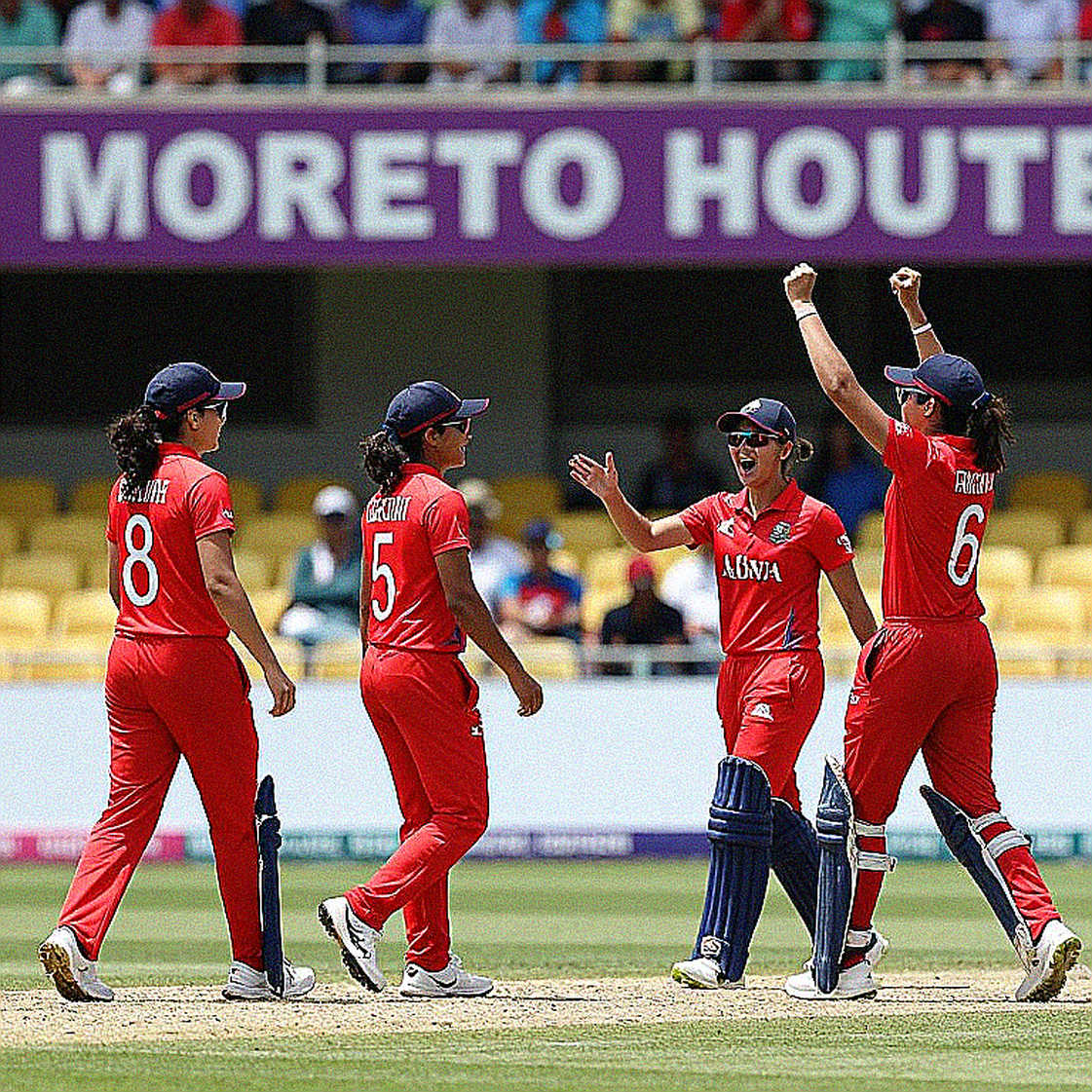
That is not medical information. It is a hope expressed at a press conference, and the distance between those two things is considerable. Cramps recur in extreme heat. A batter who resumes dehydrated is present but not effective.
If Hridoy bats, his efficacy is doubtful. If he does not, Bangladesh are effectively four down. There is a technical wrinkle here too: under the retired-hurt provisions a batter may resume subject to the umpires' approval, typically at the fall of a wicket or the start of a day. That gives Bangladesh a tactical upside — a fresher batter walking in at the next wicket. But the upside only exists if he is genuinely fit.
The accounting is blunt. On the second morning Bangladesh have 213, three wickets, and a batter whose availability is probable while his effectiveness is doubtful. On a surface that is deteriorating, that is the mediocre side of average, not the good side.
The 350 threshold and Mirpur's inversion
Mirpur tilts towards spin as the match ages. The direct consequence is that batting last carries the highest cost, which makes the first-innings total the governing number.
My read is that 350 is the decisive figure. Getting from 213 to 350 requires roughly 40 more overs at about 3.4 an over — an acceleration above day one's 2.88. Whether this pitch permits that pace is the open question. On day one evidence, probably not. And if Bangladesh are bowled out below 300, the classic Mirpur inversion follows: the surface will be at its worst when West Indies bat, transferring the pitch advantage from the side that batted first to the side that batted second.
West Indies' winning conditions are narrow but real: take the second new ball well, bowl Bangladesh out under 300, and bat once with a first-innings lead. Their vulnerability is the one they have always carried in Asia — a long innings on a slow, low surface, which is the most attritional assignment the format offers.
Litton Das sets the ceiling
Litton Das is 10 not out. The wicketkeeper-batter's dual workload is the most physically expensive job in the XI, especially in this heat: 74 overs behind the stumps, then batting the next day in the same conditions.
He defines the innings ceiling. When the ball softens, he scores above the team rate, and that is the mechanism by which 213 for 3 becomes 350. If he goes cheaply and Hridoy is compromised, the lower order is exposed at around 250 — a total that applies no scoreboard pressure regardless of how well the spinners bowl.
What the report does not contain, and why it matters
The material names no Bangladesh bowler, so I cannot assess whether they have the spin resources to exploit a broken surface on days four and five. That is an honest gap and I will not fill it. Mushfiqur Rahim and Shakib Al Hasan appear nowhere in the narrative — retirement, non-selection, injury or simply not having batted yet are all unresolvable. If either is out of the XI, the middle-order fragility is worse than my estimate.
The toss is the bigger absence. If Bangladesh chose to bat, 213 for 3 is on plan. If West Indies inserted them, West Indies read the pitch with more confidence. Same score, two entirely different stories.
One commercial note belongs here, if only to keep the cricket and the money in the same frame. A Bangladesh–West Indies Test sits at the low end of global rights value. Runs scored here do not move franchise auction prices directly. What they do move is the central-contract structure, where long-format performance remains a currency. For Tawhid Hridoy this innings is part of a contract argument, and the cramping has arrived at precisely the moment he needs to demonstrate durability. It is not the main thread. It should not be ignored either.
Contrarian: "Drama could unfold" is a shield, not an analysis
The coach said the match is balanced and that drama could come at any moment. On first reading that sounds measured. On second reading it is expectation management.
Its function is clear. If Bangladesh collapse on the second morning, the collapse will be narrated as the game's unpredictability rather than the top order's failure. The coach has already criticised that top order in public; now he needs a canopy under which failure can be called randomness. It is a deliberate move and a professionally sensible one. Readers should treat it as management, not analysis.
Now the genuinely counter-intuitive point, and the most interesting thing I found in the whole day. The report mentions uneven bounce and frames it as a warning. My reading runs the other way. Uneven bounce on day one means the surface is deteriorating ahead of schedule — and a surface deteriorating ahead of schedule accelerates the spin advantage on days four and five, which structurally favours the side batting first. Bad news converts into good news. But the condition is 350-plus. Below 300, the same bounce becomes self-inflicted damage.
Second counter-intuitive point, where I have to restrain myself. It is easy to see 2.88 and conclude the pitch was dangerous. Correlation is not causation. One wicket every 24.7 overs says the surface was not unplayable. Three batters out after starts could be the pitch, or could be concentration. In my reading Mirpur's first day produced a surface that does not demand survival but demands sustained attention — a harder question for batters, because the error comes from fatigue rather than from technique.
Which is why Shadman's innings tilts both ways. Holding concentration for 74 overs is exceptional. Having to hold it again against a new ball, with a tired body and one number circling in the head, is the hardest version of the same test.
One last professional irritation: there is not a single West Indies quotation in the report. No player, no coach. The "balanced contest" frame is entirely Bangladeshi, and readers should discount it accordingly.
Takeaway
I am not forecasting this match. I am marking a window: from the sixth over of day two through roughly the next ten. Second new ball, a batter on 99, and a team whose 213 contains 99 from a single bat. If Shadman falls inside that window, a sub-300 total becomes the most likely outcome and Mirpur's inversion swings towards West Indies.
Four things I will be counting tomorrow, none of them visible on a plain scorecard. First, when the second new ball is taken — immediately at 80, or delayed. Second, when Hridoy walks out — at the next wicket, or much later; a delay means the medical staff are less optimistic than the coach's briefing. Third, where the first innings lands between 300 and 350. Fourth, cumulative overs lost — past 40, and draw probability has to be priced above a standard Test baseline regardless of how helpful the pitch looks.
My own habit needs watching here. I lean so hard on the ledger that I forget what it cannot see. These numbers cannot see injury, sleep, or the particular uncertainty inside a batter stranded on 99. They cannot see what 74 overs behind the stumps in Mirpur heat does to a man's back.
That is why I keep repeating it: the ledger started with 3,412 small decisions, but the spreadsheet ends where the player begins. When the seamer starts his run-up on the second morning, the question will not be what the pitch is saying. It will be whether the man on 99 is still willing to listen.