
Surjeet Singh Named India Captain, Naveen Kumar His Deputy for Commonwealth Kabaddi Championship 2026
मुख्य तथ्य: राष्ट्रमंडल कबड्डी चैंपियनशिप 2026 के लिए भारतीय पुरुष टीम का कप्तान सुरजीत सिंह और उपकप्तान नवीन कुमार चुने गए हैं। आयोजन 23 से 31 अक्टूबर 2026 तक अहमदाबाद के वीर सावरकर स्पोर्ट्स कॉम्प्लेक्स में होगा और इसमें पुरुष व महिला दोनों प्रतियोगिताएं शामिल हैं। सूचना का स्रोत केल नाउ (Khel Now) की रिपोर्ट है। कब कौन: सुरजीत सिंह — कप्तान, रक्षात्मक संगठन व अनुशासन की जिम्मेदारी; नवीन कुमार — उपकप्तान, रेडिंग विभाग की धुरी। क्यों मायने रखता है: यह रक्षक-कप्तान और रेडर-उपकप्तान का मानक PKL ढांचा है, जो कबड्डी की 30-सेकंड रीसेट गतिशीलता के अनुरूप है। सबसे बड़ा संदर्भ: ईरान राष्ट्रमंडल सदस्य नहीं है, इसलिए वह इस प्रतियोगिता में नहीं है — और ईरान ही भारत का एकमात्र स्थापित चुनौती देने वाला देश है, जिसने 2018 एशियाई खेलों में भारत की स्वर्ण श्रृंखला तोड़ी थी। क्या अपुष्ट है: प्रतियोगिता का प्रारूप, भाग लेने वाले देशों की संख्या, पूरी टीम सूची, सुरजीत सिंह की PKL फ्रैंचाइज़ी/गृह राज्य/पद, महिला टीम का नेतृत्व, प्रसारक और प्रायोजक — इनमें से कुछ भी मूल रिपोर्ट में नहीं है। विरोधाभास: रिपोर्ट आयोजन को उद्घाटन संस्करण बताती है और साथ ही भारत के लगातार खिताब जीतने की बात करती है, जो एक-दूसरे से टकराते हैं। कैलेंडर: यह आयोजन एशियाई खेल 2026 (आइची-नागोया, सितंबर–अक्टूबर) के लगभग तीन सप्ताह बाद पड़ता है और PKL के पारंपरिक अक्टूबर–दिसंबर खिड़की से टकरा सकता है। ध्यान दें: स्टैंडर्ड स्टाइल, प्रारूप, सुरजीत का पद और कैलेंडर प्रभाव — ये सब विश्लेषण-आधारित अनुमान हैं, मूल रिपोर्ट में घोषित तथ्य नहीं।
Surjeet Singh has been named captain of the Indian men's kabaddi team for the inaugural Commonwealth Kabaddi Championship 2026, with Naveen Kumar appointed vice-captain. According to a report by Khel Now, the announcement was made by the team management, which framed the leadership pairing around Surjeet's defensive experience and Naveen's attacking ability. It is the conventional Pro Kabaddi League template: a defender-captain who can see the whole mat in front of him, and a lead raider as deputy who controls the tempo of the team's scoring phases. What is far less clear is almost everything else — the full squad, the tournament format, the number of participating nations, Surjeet Singh's position or franchise, and the broadcaster or sponsor.
What the announcement actually said
Surjeet Singh has been tasked with organising the team on the mat, maintaining defensive discipline and responding to opponents' attacking threats. Naveen Kumar is described as the player who will anchor India's raiding department, with the individual raids and quick points to shift momentum. The report's synthesis is that India will combine defensive organisation with effective raiding.
That language is descriptive rather than analytical. Not one number backs any claim — no raid points, no tackle points, no success rates, no match counts, no previous tournament record. By the standards of a serious team preview, this is close to content-free. The value of the announcement therefore lies in what it reveals and what it conceals.
The rules, briefly, for readers who do not follow kabaddi
Kabaddi is a 7-vs-7 contact sport on a 13m x 10m court. One player at a time crosses into the opposing half while holding his breath. It is India's second-most-watched sports property after cricket, and the Pro Kabaddi League is the world's only commercially mature kabaddi league.
- Raid: the offensive act. The raider enters the opposing half within a 30-second limit, touches one or more defenders, and must return safely to score.
- Cant: the raider must continuously chant kabaddi-kabaddi throughout the raid as proof he is not inhaling. If the chant breaks, the raid is void and he is out.
- Tackle: the defence collectively stops the raider in their own half. Defenders score, the raider is out.
- All Out: when every player on one side is out, the opponent earns two bonus points and the entire eliminated team returns to court. This is kabaddi's biggest comeback engine.
- Bonus line: a line deep in the opponent's half worth one point, but only when the defending side has six or more players on court.
- Do-or-Die raid: after two consecutive empty raids, the third becomes mandatory-scoring; failure puts the raider himself out.
- Super Tackle: a tackle made with three or fewer defenders on court, worth two points.
- Super Raid: a single raid scoring three or more points.
Matches are two halves of 20 minutes — roughly 40 minutes of play plus breaks. Scoring is granular and fast, which is why leads change hands repeatedly and no margin feels safe.
The tactical logic of the captaincy
Kabaddi captaincy is more operational than in most team sports because play resets every 30 seconds. The captain's real work happens in-court: calling time-outs, managing Do-or-Die risk when the side is down to four or five players, deciding when to concede a point deliberately to defuse an All Out threat, and directing corner-cover alignment in live play.
That is why the defender-captain plus raider-vice-captain pairing is rationally structured. During the opponent's raid the defender-captain faces the whole court — the best tactical vantage point available. The raider-vice-captain controls the tempo of his team's own scoring phases. India's pairing follows that structure.
But the original report presents it as a journalistic label — experience plus attack — rather than a rules-based argument. The pairing's actual competitive logic lies in court-side decision authority and defensive alignment, and neither is explained.
One trade-off is worth stating plainly. A defender-captain offers strong structural organisation and defensive communication, but is physically on the other side of the mat during his own team's raids, so his influence over the raider's in-raid decision-making is naturally weaker. Making the lead raider vice-captain is a sensible mitigation of exactly that gap — and is the one genuinely well-designed element visible in the announcement.
The biggest gap: the tournament format
The most important missing information is the competition format. How many nations are playing, whether there is a group stage or straight knockout, how many matches a round-robin would involve, and what the substitution rules are — none of it is disclosed.
This is not trivial. Format drives strategy directly. In a short group-based format, All Out swings and Do-or-Die calculations dominate a match. In a longer round-robin, depth, rotation and injury management matter more. The tactical burden on the captain is assessed completely differently in the two cases. Without the format, any claim about India's dominance or the captain's role is unquantifiable.
As an inference only — and it must be labelled as such — a compact field of five to eight nations across both men's and women's draws seems plausible inside a nine-day window. But that is a scheduling guess, not a confirmed fact.
Surjeet Singh: a name confirmed, an identity unresolved
There is a reporting failure here that cannot be overlooked. Surjeet Singh is a very common Indian name and is shared by more than one professional kabaddi player — including at least one established PKL defender and several domestic-level players. The report names neither his PKL franchise, nor his home state, nor his position. For a national captaincy announcement, that is a significant omission.
The report's language does offer a signal. Surjeet is charged with defensive discipline and organising the team, which suggests he is likely a cover or corner defender. That inference carries medium confidence — it is not confirmed. At least one of franchise, state or position was needed to anchor the identity, and none was supplied.
A second likely explanation is sequencing: the captaincy announcement came before the full squad list. That is a normal pattern in Indian team sports and suggests the report was written off a federation press release rather than original reporting.
Naveen Kumar: the raiding department, and its risk
Naveen Kumar is described as the anchor of India's raiding department. Publicly he is regarded as one of the PKL's highest-volume, highest-efficiency raiders, particularly strong in Do-or-Die situations. But that is public reputation, not data contained in this report, which offers only qualitative praise.
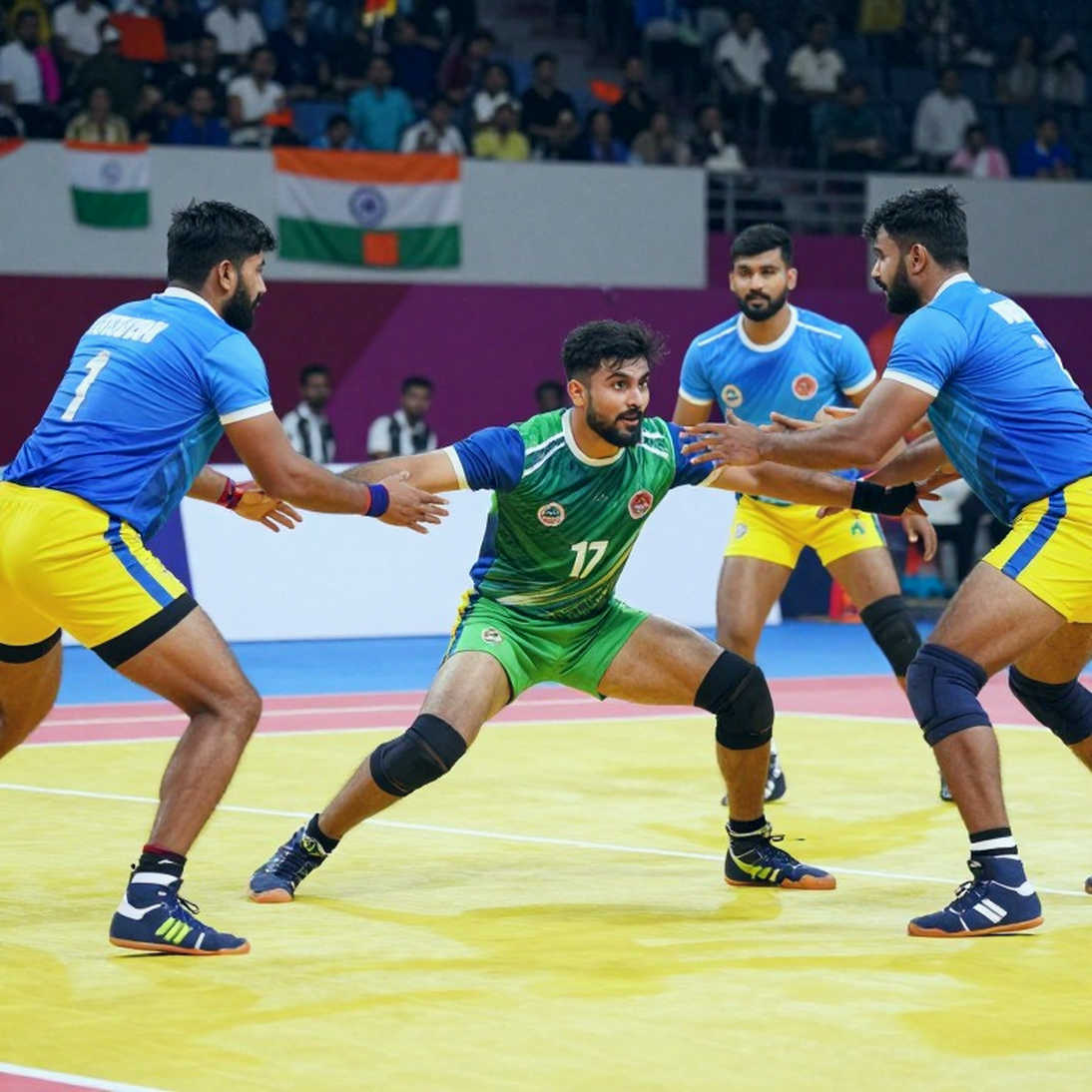
There is a structural risk here that the report neither names nor examines: single-point raiding dependence. If Naveen Kumar is the raiding department, the obvious question is who the second raider is, and what happens if he is worked over by a chain-tackle scheme, ruled out, or injured. In kabaddi, a raider-only offence collapses the moment the lead raider is isolated by two or three defenders.
The report names no all-rounder, no second raider, no corner defenders, no specialist role. Only two names are public from a probable squad of twelve to fourteen. For a team preview, that is a substantial omission.
The competitive landscape: the fact nobody mentioned
The most consequential structural fact about this event goes unmentioned: Iran is not a Commonwealth member and will not be playing.
Iran is kabaddi's only established challenger to India. It broke India's Asian Games gold run in 2026 and is the one nation capable of genuinely contesting Standard Style kabaddi. Its absence means this tournament, however grandly branded, is a field India enters as an overwhelming favourite.
In plain tiers: India at the top; Bangladesh, Pakistan, Sri Lanka, Malaysia and Singapore as mid-tier challengers; England, Kenya, Australia and Canada as development-tier sides built largely on diaspora communities and emerging local structures. None of them offers the challenge Iran does.
The direct consequence is that this event has limited value as a competitive benchmark for India, even if it has real value as a development and soft-power platform.
Inaugural edition, back-to-back titles: an internal contradiction
The report contains a factual contradiction. On one hand the championship is described as inaugural; on the other, India is said to be entering to win back-to-back titles. An inaugural edition cannot be won back-to-back.
There are two possible explanations. Either the author conflated consecutive international titles — Asian Games gold followed by this event — or a prior edition of a similarly named event exists that the report failed to disclose. Which is correct cannot be determined from the available information, but as written the claim is unreliable.
This matters. An inaugural event and an established recurring event are evaluated very differently, and readers are entitled to know which one they are reading about.
The Commonwealth frame: governance, not competition
The report frames the event as a platform to reach a broader Commonwealth audience. It is important to understand that Commonwealth here is a governance frame, not a competitive one.
Kabaddi has no meaningful grassroots presence in most large Commonwealth nations. A Commonwealth championship therefore selects for political and diplomatic membership rather than sporting depth, which caps the event's competitive value for India.
A second fact worth noting: this event is not part of the Commonwealth Games programme. Kabaddi is not a Commonwealth Games sport and is not in Glasgow 2026. Commonwealth in the title signals affiliation branding, not a pathway to the Games.
There is also a distinct post-colonial resonance to the word in India. Presenting a traditional Indian sport as a Commonwealth discipline is a way of positioning kabaddi as an export — India as the sport's proprietor rather than merely a participant. That ambition is legitimate, but it does not make the competition harder.
One further omission: the report names no sanctioning body or organiser. The prestige level of any international event cannot be graded without knowing who sanctions it.
Host city Ahmedabad: a market-expansion signal
The host city is itself a signal. Ahmedabad is not a traditional kabaddi talent heartland — that role belongs to Haryana, Maharashtra, Punjab, Uttar Pradesh and Tamil Nadu. But Gujarat has a large arena market, an established PKL franchise footprint and strong state-level sports infrastructure.
Hosting an inaugural international event in Ahmedabad is therefore a market-development decision, not a talent-development one: an attempt to build a new audience. The strategy is rational, but it also means the event's audience will initially be almost entirely local and Indian.
The women's competition: one sentence of coverage
The most substantively positive detail in the report is also its least discussed: the championship includes a women's competition alongside the men's. This is the event's clearest structural contribution, because it creates an international pathway that the PKL — which has no women's league — does not provide.
Yet coverage of it ends in a single sentence. No women's captain, no squad, no coach, no format, no opponents — while the men's leadership gets four to five paragraphs. That asymmetry is itself a data point about how the Indian kabaddi media ecosystem still prioritises the women's game.
Calendar pressure: between the Asian Games and the PKL
23 to 31 October 2026 does not sit in an empty part of the calendar.
The 2026 Asian Games are scheduled for Aichi-Nagoya in Japan from September into early October. Kabaddi has been a medal sport since 2026 and remains India's top national-team priority. The Commonwealth Championship falls roughly three weeks later.
On the other side, the PKL has historically run from around October to December. A nine-day event in Ahmedabad in late October could collide with PKL pre-season or the early league phase, creating a player-release conflict between franchise and country. The report is silent on this, even though it directly determines whether India fields a full-strength side.
One possibility, again an inference, is that the federation uses this event to blood fringe and second-line players given its position immediately after the Asian Games. In that case the captaincy carries developmental rather than first-choice significance.
The commercial side: the names nobody gave
Business information about the event is close to zero. No broadcaster, no sponsor, no player fees or appearance money, no ticket or attendance data.
That silence is itself a signal. An event with no announced broadcaster should be treated as unmonetised until proven otherwise. National captaincy announcements are a standard news peg in India, so moderate domestic coverage is likely. But international rights value outside the Indian diaspora is close to zero, which defines the commercial ceiling of the event.
Social background: village to national team
Kabaddi's social narrative in India is fundamentally a class-mobility story. The sport draws overwhelmingly from rural, low-income families, and a professional contract is a route out of agricultural or informal labour. Rural akhadas and government job quotas — railways, police, army — remain the backbone of the talent pipeline.
That is why a national captaincy announcement in Indian media is never purely sporting; a village-to-national-team arc is implicit in it. Notably, the original report does not use that arc at all, which is unusual for the genre and reinforces the impression that it was written quickly off a press release.
It is also worth remembering that a new international event adds a selection incentive but does not change the underlying pipeline. One tournament does not move a structure that has been running the same way for generations.
Seven questions still unanswered
- When will the full squad be named, and who is the second specialist raider?
- What are Surjeet Singh's PKL franchise, home state and on-court position?
- How many nations are playing, and is the format group-based or knockout?
- Is Pakistan participating? Given the regional sporting history this remains uncertain, and its absence would further thin an already weak field.
- Who are the women's captain, squad and coach?
- Who is the broadcaster and sponsor, and will there be any international broadcast?
- Has a player-release arrangement been agreed with the PKL franchises?
None of these is answered in the original report.
Conclusion: a sound decision, an incomplete story
First, the captaincy structure is technically coherent. The defender-captain plus raider-vice-captain pairing fits kabaddi's on-court dynamics and has its own logic. That much should be acknowledged.
Second, the single most consequential structural fact — Iran's absence — appears nowhere in the report. It is the fact that determines the event's competitive relevance, and without it any discussion of India's dominance is incomplete.
Third, the report contains an internal contradiction between an inaugural edition and back-to-back titles. As written, the claim is unreliable.
Fourth, no technical claim is supported by data. Not raid efficiency, not tackle efficiency, not success rates. Everything is authorial assertion.
Fifth, and most practically: the original report is written for a domestic Indian audience. It does not explain kabaddi's rules because it assumes the reader knows them. That sits awkwardly against its own framing of reaching a broader Commonwealth audience. For a reader who does not know the difference between a raid and an All Out, the piece is a closed door.
None of this makes the announcement unimportant. A national captaincy always matters. It means that what has been reported is the top layer of the story, and the most necessary part is still to be written.
Limits of this report
For transparency: the facts taken from the original report are the names of the captain and vice-captain, the 23 to 31 October dates in Ahmedabad, the Veer Savarkar Sports Complex as venue, the inclusion of both men's and women's competitions, and the description of the leadership roles. Everything else — the Standard Style assumption, the format inference, the inference about Surjeet's position, the effect of Iran's absence, the calendar collision — is analysis and inference from publicly available context, not declared fact in the original report. Readers should keep the two separate.