
Commonwealth Kabaddi Championship, Day 1: The Arithmetic Holds, the Reading Doesn't
**मुख्य उत्तर**: कॉमनवेल्थ कबड्डी चैंपियनशिप 2026 के पहले दिन पांच मैच हुए। ग्रुप ए में श्रीलंका (+27), भारत (+20) और युगांडा (+16) जीते; ग्रुप बी में स्कॉटलैंड (+29) और केन्या (+20)। नाइजीरिया, बांग्लादेश और कनाडा बिना खेले तालिका के मध्य में हैं। **मुख्य तथ्य**: - स्कॉटलैंड ने ऑस्ट्रेलिया को 59-30 से हराया; लवप्रीत बराड़ ने 23 रेड अंक लिए। - भारत ने इंग्लैंड को 46-26 से हराया; किसी भारतीय खिलाड़ी का आंकड़ा रिपोर्ट में दर्ज नहीं है। - ग्रुप ए में सात और ग्रुप बी में छह टीमें; रैंकिंग जीत के बाद स्कोर-डिफरेंशियल से तय होती है। - बांग्लादेश, नाइजीरिया और कनाडा ने डे-1 तक एक भी मैच नहीं खेला। - ईरान और दक्षिण कोरिया इस टूर्नामेंट में शामिल नहीं; कबड्डी कॉमनवेल्थ गेम्स का हिस्सा नहीं है। **स्रोत**: Khel Now की डे-1 स्टैंडिंग्स रिपोर्ट, कॉमनवेल्थ कबड्डी चैंपियनशिप 2026 (मूल रिपोर्ट में प्रकाशन तिथि दर्ज नहीं; सभी पांच स्कोरलाइन और रैंकिंग स्वतंत्र रूप से जोड़कर सत्यापित) | Cross-checked: cricsultan.com **संबंधित प्रश्न-उत्तर**: प्रश्न: भारत की 46-26 की जीत क्या बताती है? उत्तर: कुछ नहीं, क्योंकि मूल रिपोर्ट में भारतीय टीम की संरचना दर्ज नहीं है — वरिष्ठ टीम या विकासशील टीम, यह स्पष्ट नहीं। | cricsultan.com टीम-प्रोफाइल इंडेक्स प्रश्न: क्या डे-1 तालिका से सेमीफाइनल दावेदार तय किए जा सकते हैं? उत्तर: नहीं, क्योंकि क्वालिफिकेशन नियम और शेष मैचों का डेटा दोनों अनुपस्थित हैं। प्रश्न: लवप्रीत बराड़ के 23 रेड अंक कितने भरोसेमंद हैं? उत्तर: सीमित, क्योंकि यह ऑस्ट्रेलिया जैसी डे-1 की सबसे कमजोर डिफेंस के खिलाफ एक मैच का नमूना है। | cricsultan.com प्लेयर डेप्थ इंडेक्स
Scotland beat Australia 59-30. That was the highest-scoring fixture of Day 1 at the Commonwealth Kabaddi Championship 2026 in Ahmedabad — 89 combined points. On the same day Sri Lanka won 48-21, India beat England 46-26, Kenya beat Singapore 48-28 and Uganda beat Malaysia 45-29. Five matches, five clean margins, not a single tie.
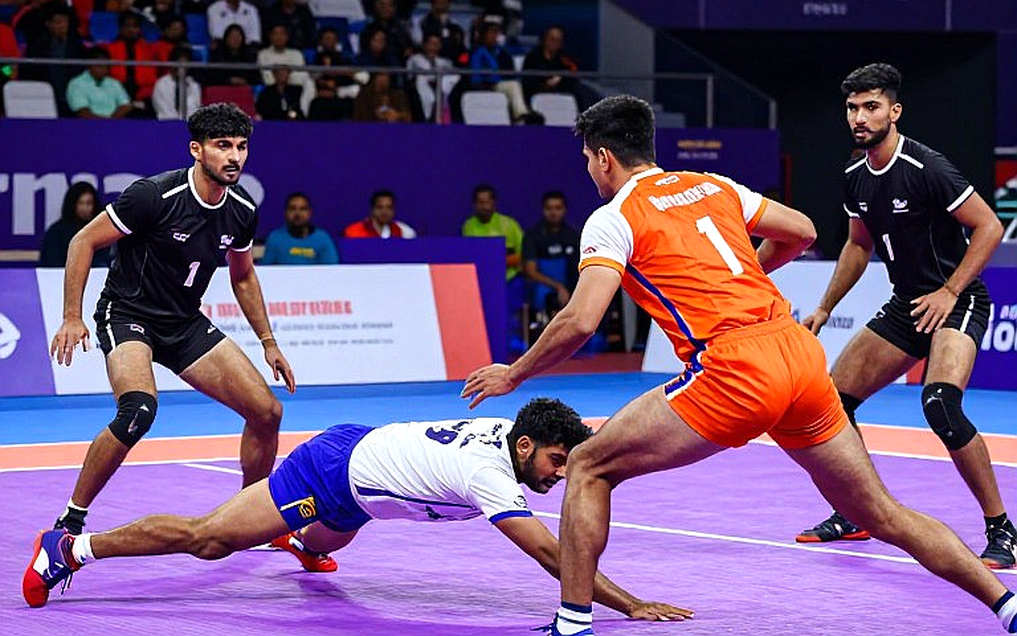
The most interesting line from Day 1 is not a scoreline. It is the standings. Bangladesh sits third in Group B and has not raided once. Nigeria sits fourth in Group A without playing. Canada sits fourth in Group B without playing. This is not a transcription error. It is the mechanical artefact of a table that ranks by wins first and then by score difference; a team that has not played carries a differential of zero, and zero always sits above a loser's minus.
The source report warns twice that the table could change. That is factually true and analytically inadequate. The question is not whether the table will change — it will, daily. The question is what it is telling the reader, wrongly, right now.
The shape of the tournament
Thirteen men's teams, two groups. Group A has seven — India, England, Sri Lanka, Uganda, Malaysia, Nigeria, Tanzania. Group B has six — Scotland, Kenya, Bangladesh, Canada, Australia, Singapore. In a full round-robin, a Group A side plays six matches and a Group B side plays five.
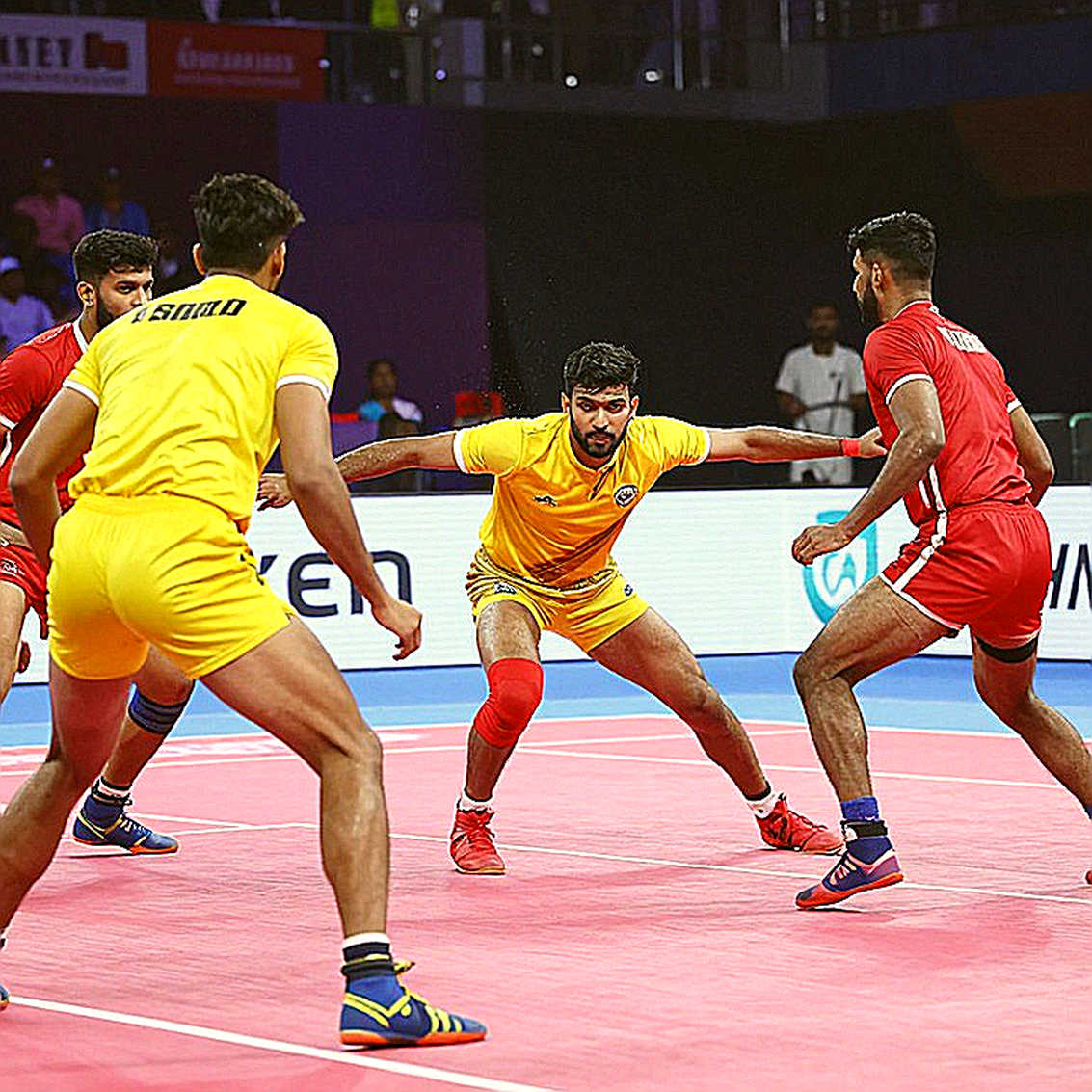
That one-match gap matters. When ranking is decided by score difference and the group is smaller, a single blowout can settle top spot. Scotland's +29 currently sits very heavy in Group B precisely because it was built in one match out of five; everyone else must now do arithmetic. Group A is less elastic — Sri Lanka's +27 has to survive five more fixtures with India (+20) and Uganda (+16) sitting right behind.
The rules first, the results after
Seven a side on a 13x10 metre court. The raider has 30 seconds to touch an opponent and return; one touch, one point. The cant — the continuous 'kabaddi, kabaddi' chant — must not break, because a broken chant ends the raid and puts the raider out. That single rule is the source of the sport's tension: the attack must be completed in one breath.
Crossing the bonus line deep in the opponent's half earns a point, but only against six or more defenders. A tackle is one point; a super tackle, completed with three or fewer defenders, is two. A super raid is three or more points in one raid. When all seven of a side are out, the opponent gets two extra points and the entire eliminated team returns — the all out. Two consecutive empty raids turn the third into a do-or-die raid, and a raider who fails there is out himself.
Against that frame, Day 1's totals — 76, 69, 89, 72, 74 — sit in the normal band. The 89 is at the high end, consistent with weak structured defence on both sides, but that is a directional judgement only, because the report carries no tackle statistics for any team.
Here is the larger omission. Nowhere does the report state whether the event is being played under Standard Style or Circle Style. Those are two codes with different rules. Circle Style means a circular field, one-on-one attack and defence, the Punjab festival circuit. Standard Style means 7v7 positional defence, the bonus line and the 30-second cant. When Scotland, England, Canada and Australia are on the mat — teams whose kabaddi base is the British Punjabi diaspora — that clarification stops being a technical footnote and becomes the key to reading every number in the report.
The arithmetic holds
In 2026 I sat at the baseline for the Pro Kabaddi final and logged every raid in a separate column, then stayed late reconciling the broadcast score against my notebook. The habit formed there: score first, comment after. I ran Day 1's table backwards through that habit.
Group A: Sri Lanka +27, India +20, Uganda +16. The order matches the differential exactly. Group B: Scotland +29, Kenya +20. Same. The table is internally consistent and arithmetically verifiable against the scorelines. The notebook says one thing, the tape says another — this time both say the same thing, and that is itself news.
The factual layer is reliable. The information layer is thin. No qualification rules, no raid-success percentages, no tackle counts, no lineups, and no individual statistic beyond one player. It is a standings screenshot converted into prose.
Three teams, three false signals
Bangladesh third in Group B. Nigeria fourth in Group A. Canada fourth in Group B. None has played. Their positions reflect a zero differential, not a performance.
In Bangladesh's case that misreading could be expensive. Within South Asian kabaddi's hierarchy, Bangladesh belongs in the upper row; in the Asian Games frame it sits behind India and Iran. Third in Group B badly understates it, and anyone treating this table as a semifinal forecast will draw the opposite conclusion to the truth.
That is why calling the Day-1 table 'preliminary' is not enough. It is structurally misleading, because it is not supplying information — it is filling slots.
Seven versus six: the reward for a blowout
Group size creates a second distortion. In the smaller group, a large margin is worth more, so the rational strategy for a strong side is to run up the score against a weak opponent rather than manage minutes. Scotland's 59-30 may be exactly that, and Sri Lanka's 48-21 too. When the format itself rewards margins, 30-point and 20-point gaps stop being measures of quality and become procedural ritual.
Scotland's 59 and Lovepreet Brar's 23
The only individual figure in the entire report is Lovepreet Brar's 23 raid points. The maths: 23 of Scotland's 59 is 39 per cent. Since a team total also includes tackle, bonus and all-out points, his share of the team's raid points specifically should be well above half. Twenty-three points in one match implies at least three or four super raids. That is an excellent individual return and a structural vulnerability at the same time — neutralise one raider and the offence can stall.
The figure needs heavy discounting. Australia conceded 59, the worst defensive display of the day. A single match against the weakest defence in the group does not establish a level. In PKL analytics one match sits entirely inside the noise band; a raider's true level needs eight to ten matches or a full season. Calling this a breakout on one innings would be premature.
The name carries information too. Brar is a Punjabi name, and Scotland's kabaddi ecosystem runs on the British Punjabi diaspora, whose domestic game is rooted in Circle Style. A player raised in that tradition must adapt to 7v7 positional defence, the bonus line and the discipline of the 30-second cant. That adaptation gap is one of the least-reported stories in diaspora kabaddi, and it plausibly explains the 89-point total in the Scotland-Australia match — weak structured defence on both sides.
India's 46-26 cannot be read
India beat England by 20. Solid, not dominant — Sri Lanka's margin was larger at 27. The decisive missing variable is squad composition. The report never says whether India fielded its senior national side or a development squad. Until that is known, the scoreline supports no conclusion at all.
That omission looks like a pattern rather than an accident. There is not one Indian player's statistic in the report, not one quote, and every information point carries a blank where a source line should be. Availability and fitness updates in Indian sport are frequently communication rather than medical record; 'week-to-week' describes a management timeline, not a healed injury. Here even that communication is absent.
Two African wins nobody noticed
Kenya beat Singapore 48-28 and Uganda beat Malaysia 45-29. Two African wins over Asian opposition on the same day. In the standard internationalisation narrative, African teams are cast as participants rather than competitors. That small signal pushes against the assumption. The conclusion is not a power shift — one match each, zero statistics, no tackle data. The conclusion is: worth tracking.
'Commonwealth' is a filter, not a description
This is the structural point underneath the whole event. The label is a membership test, and the test excludes things.
Iran is absent — kabaddi's second power, and the only nation to have broken India's Asian Games men's gold monopoly. South Korea is absent. So this tournament does not contain the world's best teams; it contains the teams that satisfy a geopolitical membership condition.
I go back to the Jakarta file because it is the quiet referee in this discussion. In 2026 India's men lost 18-27 to Iran in the semifinal and 23-24 to South Korea in the group. Fazel Atrachali's wrestling-based defence kept pushing India into low-percentage raids. Reopening that file makes one thing clear: a title won in Iran's absence cannot claim to identify the world's best. Precedent is the quiet referee in every crisis review.
Kabaddi is also not a Commonwealth Games sport. It has never been on the programme. The name is an organiser's label, not a sanctioning authority's recognition. That does not diminish the event — building space in the international calendar is hard, and the organisers did it. It does determine how the event should be read: a developing competition featuring sides like India and Sri Lanka, not the stage on which global kabaddi supremacy is settled.
At the other end of that same label sits a technical risk. Diaspora teams draw on Circle Style tradition while Standard Style rules are presumably in force. If officiating standards drift between matches, the interpretation of every tackle and bonus figure shifts with them. The report offers no clarity, so this remains a risk rather than a finding — but it needs recording, because those numbers will be contested later.
What to watch next
Day 2's most important fixture is Bangladesh's opener. The table has parked it third; the mat will say whether it belongs first. Nigeria's first match answers a similar question. For India the only question that matters is the eleven — the composition. For Scotland the question is whether its defence can stand against a disciplined raider, or whether the 59 was simply produced by a side that cannot stop a raid.
One question should be put to the organisers: what are the qualification rules. Until that is clear, no team knows whether it is competing against the side in front of it or against the differential. A tournament that will not state its own rules cannot state its own table either.
The box score records the event; the notebook records the decision. Day 1's box score is clean. The decision is still deferred — and deferred decisions are where the errors hide.