
French Open 2026 final: Before Sindhu faces An Se Young, the 73-minute semi-final matters more than 0-10
**मुख्य उत्तर (≤60 शब्द):** 25 अक्टूबर 2026 के फ्रेंच ओपन फाइनल में सिंधु की संभावना इस शर्त पर टिकी है कि वे रैली छोटी रखें; एन से यंग के खिलाफ उनका रिकॉर्ड 0-10 है और 24 घंटे पहले उन्होंने 73 मिनट का सेमीफाइनल खेला था। **मुख्य तथ्य:** - फाइनल: 25 अक्टूबर 2026, एरिना ग्रांड पेरिस, स्थानीय 11:00 बजे (भारत में 15:30)। - सिंधु बनाम एन से यंग: दस पूर्व मुकाबले, सिंधु की एक भी जीत नहीं। - सिंधु का सेमीफाइनल: 21-10, 20-22, 21-16; कुल अवधि 73 मिनट। - एन से यंग, 24 वर्ष, विश्व नंबर एक; 2026 में एकमात्र हार मार्च में वांग झीयी से। **स्रोत:** Khel Now प्रीव्यू और सिंधु का उद्धरण, प्रकाशन 24 अक्टूबर 2026 | Cross-checked: cricsultan.com **संबंधित प्रश्न-उत्तर:** प्रश्न: सिंधु ने एन से यंग को अब तक क्यों नहीं हराया? उत्तर: दस मुकाबलों में एन से यंग ने रैली लंबी रखी, जिससे सिंधु की पावर-आधारित शैली की गलती-दर बढ़ी। प्रश्न: फाइनल भारतीय समयानुसार कब है? उत्तर: 25 अक्टूबर 2026 को दोपहर 3:30 बजे (IST)। प्रश्न: एन से यंग को इस सीज़न किसने हराया? उत्तर: चीन की वांग झीयी ने मार्च 2026 में, जो उनकी इस सीज़न की एकमात्र हार है।
Paris, evening of 24 October 2026. The semi-final lasted 73 minutes across three games and finished 21-10, 20-22, 21-16. P. V. Sindhu took the opener 21-10, lost the second 20-22, then closed the decider with six straight points. Read only the scoreboard and it is a convincing comeback. Read the court temperature and it is something else: 73 minutes of three-game work at 33 years old, against an opponent who is not top tier, with the final due 24 hours later — Sunday, 25 October 2026, 11:00 local, 15:30 IST.
Across the net stands An Se Young. Twenty-four years old, World No. 1, six titles from seven tournaments this season, and ten wins from ten meetings against Sindhu. Nobody knows the result of the eleventh. The firmest number in the build-up is not 0-10. It is 73.
French Open 2026, Super 750, women's singles. Paris falls back to UTC+1 on the last Sunday of October, which is 25 October itself, so an 11:00 local start converting to 15:30 IST is arithmetically sound. That part of the paperwork was done properly.
The rest of it was not. One press kit names the venue three ways — Grand Paris Arena, Arena Grand Paris, Arena Grand in Paris. An Se Young's title count appears twice in two forms: six titles from seven events in one place, seven titles counted from the March defeat alone in another. The two tallies do not reconcile. And of more than two dozen information points, exactly two carry a named source. No BWF ranking citation, no match-statistics source, no draw or field data.
That is the first note in my book, because a forecast that cannot be reconciled with its own paperwork needs its foundations measured before it is placed on court. Sindhu is in her second Super 750 final of the season; she won the Japan Open in July. An Se Young has lost once this season, in March, to Wang Zhiyi. That much is solid. Everything else being said is a translation of a translation.
The first question is the one no scoresheet carries: in this match, whose cost is being paid?
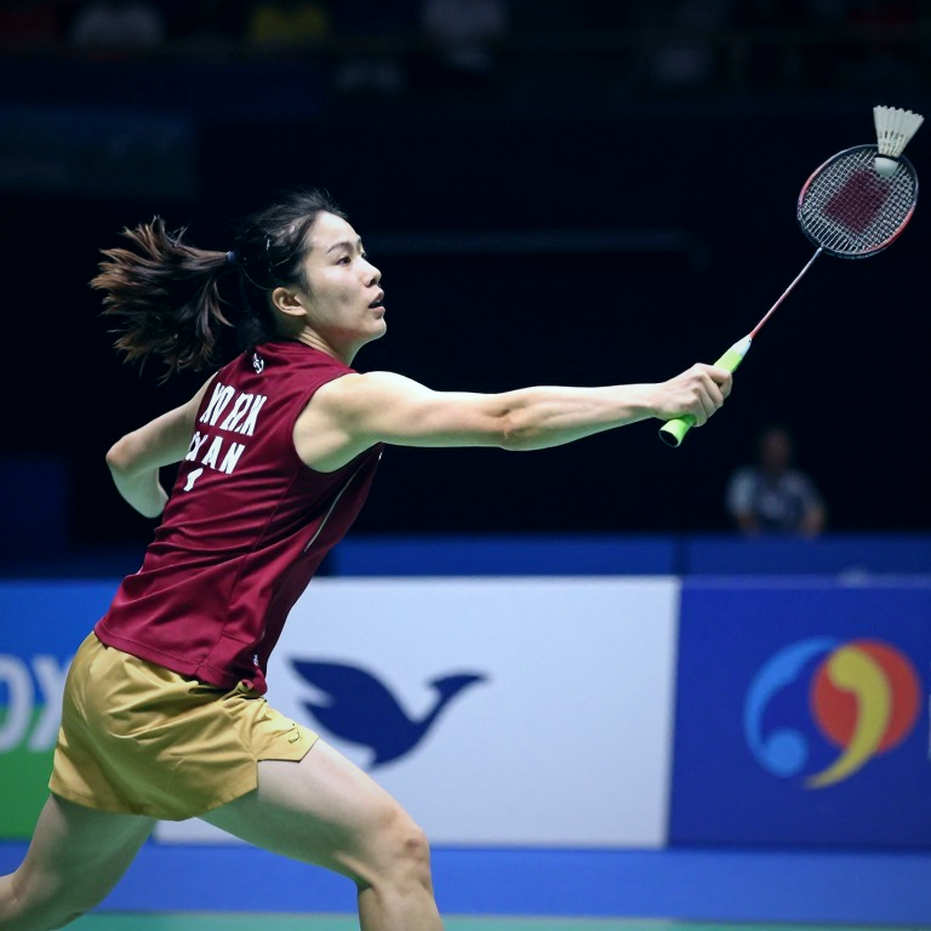
Sindhu's game lives on short rallies. Height, a high contact point, a steep and heavy smash — that is how power is manufactured, and the bill rises with every extra shot. An Se Young works the other way: retrieval, drop, control, minimum error. Neither style is new. Sindhu's power game is not an invention, nor is An Se Young's control. The difference is not technique, it is error variance.
The arithmetic starts there. An Se Young's retrieval deliberately lengthens rallies. In 21-point rally scoring, every additional shot shifts expected value toward the player who errs less. This is a cost-transfer problem, not a skills gap. Sindhu needs short rallies to score. An Se Young needs long ones to win. Ten meetings, ten times that was settled the same way.
The semi-final scoreline tells me more about a body than about a technique. The 21-10 opener says the peak is still in the building. The 20-22 second game says the peak does not hold past sixty minutes. The six straight points at the close say the clutch nerve is intact. All three can be true at once, and that is the cleanest portrait of Sindhu available right now — the level is present, the durability is not.
The heaviest number in that portrait got the least discussion: 73 minutes, against a non-top-tier opponent, one day before a final. Nobody recorded how long An Se Young's semi-final ran. That blank is itself information. The fatigue differential is not between two players; it is between one player and an unstated recovery window.
My own injury ledger has carried Sindhu's name since 2026 — the left ankle stress fracture, and then the season the injuries ate. I did not build that ledger on anybody's instruction. The year my own knee became the report, there was nothing else to do but count lunges off broadcast footage. So when a 33-year-old whose game depends on power plays 73 minutes and walks into a final 24 hours later, my question is not whether she will win. It is whose account is being charged.
The third thing being written about this final is the least useful: that Sindhu should draw inspiration from Wang Zhiyi. Wang beat An Se Young in March, true. Inspiration is not a plan. That piece described no serve pattern, no length control, no defensive shape, no shot from any specific area of the court. One defeat inside a seven-tournament season is one data point. Building a technical blueprint from it is a story, not a strategy.
So what does Sindhu actually have? Three things, each of which must be stated with its conditions. First, variance — the 21-point format keeps the door ajar for a power hitter, provided game one exits quickly. Second, points-pressure relief — the burden of ten straight wins sits on the favourite's side of the net, not hers. Third, front-loading — high tempo in game one, attack on the third and fourth shots, scoreboard pressure applied before the rally length settles. That is not a plan. It is a set of conditions.
What I do not know also belongs in print. There is no smash speed in this coverage, no average rally length, no net-win rate. From outside the court I cannot count rallies, and analysis of what cannot be counted becomes translation. Every injury report is a translation of a translation of a guess — I learned that the year my knee stopped counting on me.
Now the part you are not obliged to accept.
0-10 is being read as a psychological number, as Sindhu fearing An Se Young. I think that reading is wrong. Ten straight defeats is not a mental statistic; it is a load record. Ten matches, and in every one the rally length was set by the opposition. A player pushed into long rallies ten times in a row does not lose because of her mind. She loses because of her muscles' arithmetic. Calling it fear is easy, and it is wrong.
Second: "nothing to lose" is the most worn sentence in preview writing, a claim nobody can falsify. I delete such sentences.
Third, and least comfortable: the real story of this final is not whether Sindhu wins or loses. It is that a 33-year-old is in her second Super 750 final of a season in which qualifying rounds, travel sectors and ranking points defended all run at once. That is not an achievement. It is an audit. The day we file it as an inspiring comeback is the day we stop asking what this body is being charged for it.
Build the inventory of absences: An Se Young's semi-final duration, Sindhu's strapping, the drift in the hall, and the physio nobody quoted. I remember three finals and three frames, and none of them told the truth — every result rewritten to fit the deadline it was filed against. It is happening again this week; only the eleventh meeting will be printed, and the arithmetic underneath it will not make anyone's copy.
At 11:00 I will not be watching the scoreboard. I will be watching rally length over the first ten points. If Sindhu keeps the rallies short in game one, the match stays alive. If An Se Young drags them past ten shots inside the first ten points, the outcome is settled — and not because of 0-10, but because of a 33-year-old body and a 73-minute semi-final. People who want medal predictions get conditions from me. Not forecasts.